AI-Driven Chip Verification

The verification bottleneck
has a fix.

See

Singularity replaces the decades-old technology backplanes behind bug-finding and debug — cutting time to market by 50%, not just cost, for a $500B+ semiconductor industry.

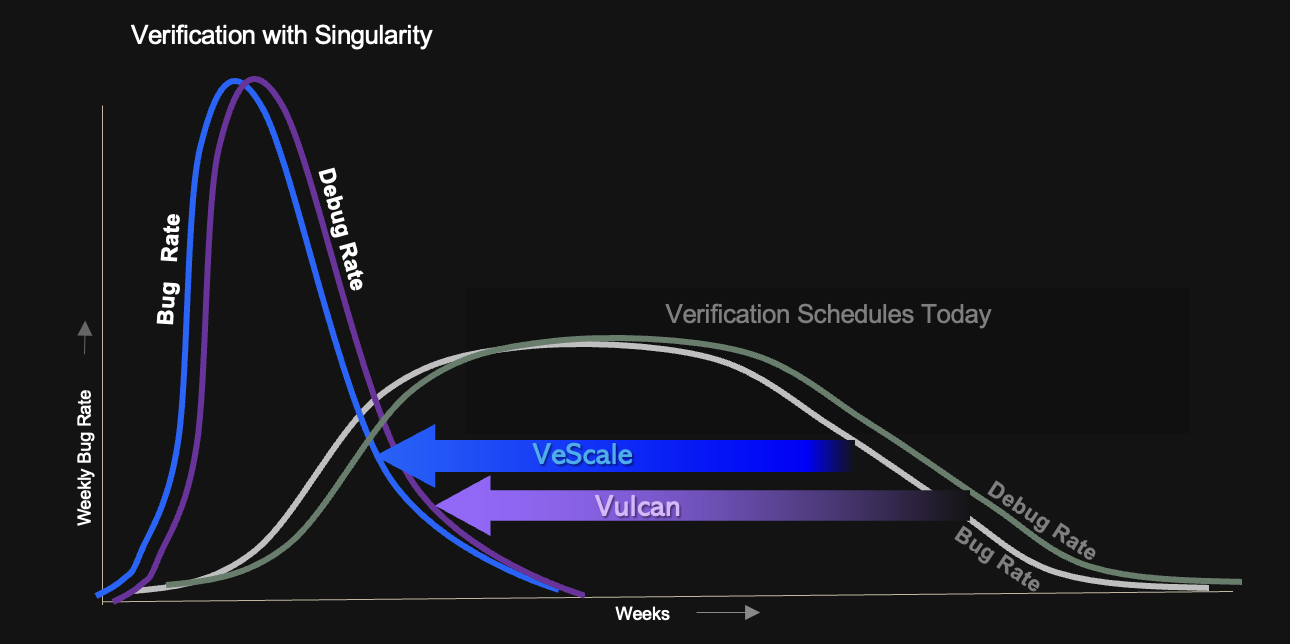
Chart showing weekly bug rate over time: Singularity's VeScale and Vulcan curves spike early and drop off fast, while today's verification schedule stays elevated for a long tail. Horizontal arrows compare the resulting schedule lengths.

The Bottleneck

Chips are built in months. They're verified for years.

Finding and fixing all the bugs in a design routinely takes much longer than designing it in the first place. Every extra week of verification is a week of revenue lost — and the bug finding methodologies and debug frameworks teams rely on haven't fundamentally changed in decades.

$500B+

Semiconductor industry Singularity serves

50%

Reduction in verification schedules

De-risks Agentic Debug

Vulcan speeds up the costly but unavoidable re-validation step by 10x

Technology

Two Systems, AI driven Backplane Changes

Instead of using Agentic AI to simply automate manual steps around old frameworks, Singularity changes the very technology backplanes underneath both bug-finding and debug — the two halves of verification that determine how fast a chip actually ships.

Bug Finding

VeScale

An AI-powered rapid bug finder that drives the weekly bug rate down faster than traditional constrained-random and coverage-driven flows.

  • Finds the bugs that matter earlier in the schedule
  • Works directly off of the RTL
  • Directly shortens the verification schedule, not just engineer hours

Debug

Vulcan

An AI-powered debug framework designed to slot in where archaic, decades-old debug tools currently bottleneck root-cause and fix.

  • Under an hour to switch permanently from your current debug framework
  • 10x faster debug throughput than industry-standard tools
  • Supports rapid micro-arch/RTL upskilling and other extensions no other frameworks offer

Why This Is Different

Automating the backplane isn't the same as changing it.

Pure Agentic AI plays point automation at the manual effort sitting on top of today's bug-finding and debug backplane — the tools underneath stay exactly as they were. Singularity changes the backplanes themselves, which is what turns the result into a direct impact on time-to-money and competitive edge, not simply a productivity improvement.

Other agentic AI approaches

Manual effort Automated effort

Same backplane. Efficiency and cost gains.

  • Automate the manual steps around the existing framework, aiming to reduce headcount
  • Leave the long pole — the underlying technology backplanes — untouched
  • A wrong fix from a hallucinating LLM still needs full manual re-validation before sign-off
  • ROI framed as cost reduction or productivity gains

Singularity

Old backplane New backplane

Direct time-to-money impact. Decisive competitive edge.

  • Replaces the bug-finding and debug backplane itself — a fundamental change
  • Covers the full problem: bug finding and debug resolution, end to end
  • Pairs agentic coding/debug support with fast re-verification in full RTL context
  • ROI is a direct time-to-market reduction — the bigger lever besides cost, efficiency

Vulcan, In Practice

Built ground up for the AI era.
Addresses and de-risks agentic AI debug.

Agentic root-cause-and-fix only pays off if engineers can verify its outputs fast enough to trust it. Vulcan is built to close that gap rather than replace the AI doing the fixing.

The hallucination problem

High hallucination rates mean every agentic fix needs verification before sign-off. Vulcan's 10x faster debug throughput makes that re-verification step fast enough that agentic debug's full ROI is actually realized, instead of bottlenecked behind manual checking.

The talent paradox

LLMs threaten to eliminate the junior-engineer work that trains future senior engineers. By making RTL/micro-arch upskilling dramatically faster, Vulcan keeps that pipeline open rather than closing it.

Leadership

Founder-market fit, built over 22 years at Intel.

Harish Kumar

Founder & CEO

22 years at Intel across architecture, RTL/validation, and circuit design — conception to launch on Pentium Pro, Pentium 4, Core2 Duo, i3/i5, and Xeon server platforms.

Built and led a 100+ engineer CPU post-silicon system architecture validation organization, including production sign-off on Beckton, Intel's first point-to-point Xeon product.

3 patents, 200+ citations

Satish Kambalimath

Strategic Marketing Consultant

Ex-Cadence, IBM, and Lucent, with decades in chip design, EDA, and formal verification tools.

Led Cadence's worldwide sales and business development for system and functional verification, managing a $250M product line.

Designed and ran global pilot programs that turned into reference customers across wireless, multimedia, and automotive.

Advisors

Backed by people who have shipped Industry defining chips.

Sunil Shenoy

Senior VP Engineering (emeritus), Intel
Investor in Singularity

GM of overall microprocessor and SOC development at Intel; previously Senior VP at SiFive. Led co-GM roles across Intel's Visual & Parallel Computing Group and Enterprise Microprocessor Group, responsible for products including Pentium 4, i3/i5, and Xeon Phi.

Rohit Vidwans

Chief Engineering & Manufacturing Officer, Ampere Computing
Investor in Singularity

Formerly VP of SOC development at Intel, responsible for the overall development and delivery of Intel's first quad-core ATOM-based SOC and platform.

Investors Who Have Bet on Semiconductor Deeptech Before

Startup Xseed 3one4 Capital Inflexor Ventures Kettleborough VC

Careers

We're hiring across RTL Verification, AI/ML, Software development, Technical Marketing and Application engineering roles.

Please mail your CV to careers@singularityd.com

Talk To Us

If you would like to see how Vulcan and VeScale could change your verification cycle time and time to market schedule, send us a note to harish.kumar@singularityd.com

Note: We're currently deep in a pilot with a major CPU design company. We're taking a limited number of additional design partners as we scale our team to match demand — reach out and we'll let you know where we stand.